

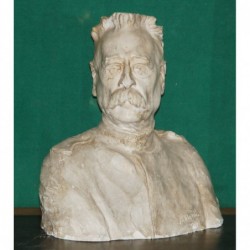
A rare plaster bust depicting General Gaetano Gobbo, dated 1916 and created by the sculptor Michelangelo Monti.
A valuable work with meticulously detailed facial features and uniform, it retains its original patina and minor signs of wear consistent with its age. A historical and artistic piece of great collector's interest, highly sought after by enthusiasts of military portraiture and early 20th-century Italian sculpture. Michelangelo Monti (Milan 1875 - Turin 1946) Son of a renowned founder of Italian fencing, a fencer himself, Michelangelo Monti was a proud and resolute figure and spirited volunteer in the Great War. Born in Milan in 1875, he is one of the most interesting figures in our artistic scene. The sometimes almost military tone and rough authority that certain aspects of his character assume did not prevent his artistic spirit from freely expressing itself in his works and in his life. At Brera, he studied with Ernesto Barzaghi, Enrico Butti, and Ernesto Bazzaro, and completed his studies at the Albertina in Turin with Tabacchi. From 1896 to 1899, he lived in the artistic atmosphere of Leonardo Bistolfi. He participated in the First Quadrennial Exhibition in Turin in 1902 with the sculpture Rovi e Spine. With the plaster group, Mio!, he participated in the National Exhibition of Fine Arts in the autumn of 1912 at the Royal Academy of Fine Arts in Milan. From March 30 to June 30, 1921, he appeared at the First Roman Biennale with the sculpture L’aquila. In 1922, he presented a Madonna at the First International Art Exhibition in Sanremo. He exhibited at the Second Roman Biennale, the International Exhibition of Fine Arts, at the Palazzo delle Belle Arti in Rome, with the sculpture Maternità, held from November 4, 1923, to April 30, 1924. In 1923, he created the monument dedicated to the Fallen of the Second Alpine Regiment in Cuneo, and the one in Castellamonte (inaugurated on October 28, 1923). In 1924, he created the monument to the Fallen of San Francesco al Campo (Turin). In 1925, he created the monuments to the Fallen of the Great War in San Maurizio Canavese (1925), and the one in Pomponesco (Mantua), inaugurated on October 11, 1925. He also created the monuments to the Fallen of Corio Canavese and the one in Momo (Novara), inaugurated in 1928.