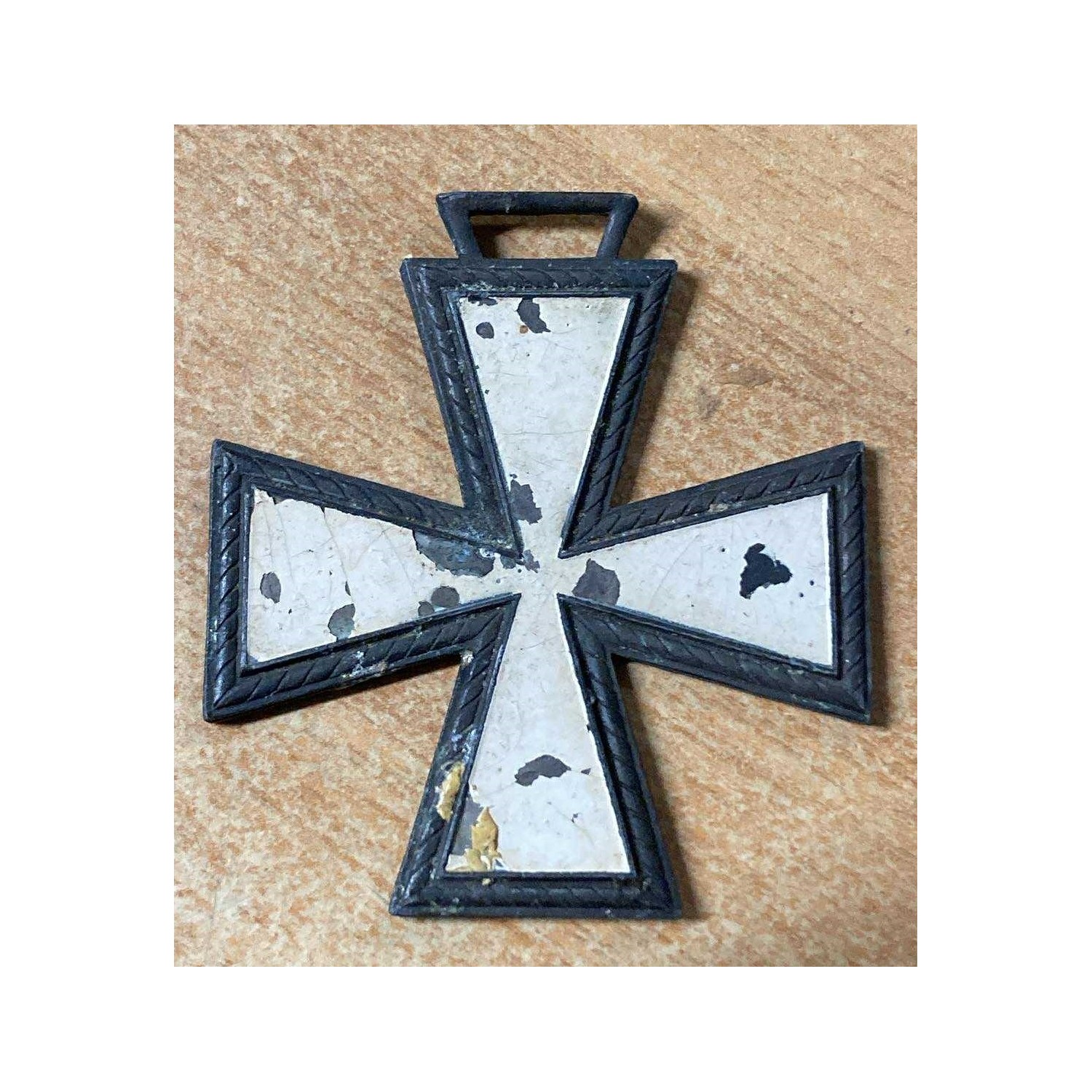
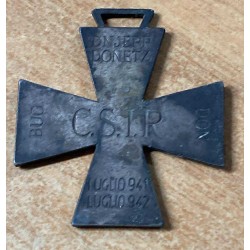
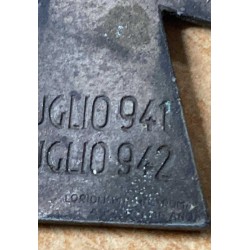
CSIR Cross Medal, known as the Ice Cross, veterans of the Russian Front, produced by Lorioli of Milan.
The Italian Expeditionary Force in Russia, often abbreviated as CSIR, was a large unit of the Royal Army sent in the summer of 1941 as a contingent to support the German forces engaged in Operation Barbarossa on the Eastern Front against the Soviet Union. From July 10th to August 5th, troops were transported from Rome (52nd Infantry Division "Turin"), Cremona (CSIR Command), and Verona (9th Infantry Division "Pasubio" and 3rd Rapid Reconnaissance Division "Principe Amedeo Duca d'Aosta") via 216 trains to the then Hungarian, now Romanian, cities of Marmaros Sziget, Felsővisó, and Borșa. From there, after crossing the Eastern Carpathians, they reached first the assembly area in Romania and then the theater of operations with a march of hundreds of kilometers across the poor roads of Eastern Europe. This long march, which many units had to undertake on foot or on horseback due to a lack of vehicles, caused a certain delay compared to the schedule. The CSIR entered into action for the first time in August 1941. After crossing the Dniester at several points and establishing several bridgeheads, the Germans were attempting to corner the Soviet forces stationed between the Dniester and the Bug. In some places, however, the Russians were putting up strong resistance, and new forces were needed to fuel the offensive. At the end of July, with the CSIR still in the process of organizing, General Eberhard von Mackensen, commander of the German III Corps, requested from General Messe at least one division for immediate use in battle and two artillery groups to support his attack on the Soviet forces. On July 30, the "Pasubio" was urgently sent to the front, reinforced by a motorcycle company and the 30th Artillery Group.